Search This Blog

Showing posts with label 1920s. Show all posts

Thursday, October 30, 2014

Mysery History -- Solved!


Helen* wins with her 2:46 p.m. Tuesday guess "Building or repairing the dome of City Hall?"

In the 1926 photo above, the dome at Pasadena City Hall is under construction. 

The dome sits above the tower and below the cupola in this 1927 photo when construction of City Hall is near completion.


City Hall was built before union rules, OSHA and other modern safeguards. The workers in 1926 and 1927, most of them local, didn't have hard hats, back support belts, knee pads, steel-toed boots and nail guns; what they did have was a strong ethic for hard, honest work.


There are hundreds of photos in this series shot by photographer Albert Hiller, who was 42 years old and nationally renowned when he was commissioned by the City of Pasadena to document the construction of City Hall. The photos are mostly in albums that are part of the historical collection in the Centennial Room at Pasadena Central Library.  Hiller lived in Pasadena and had a studio at 49 E. Colorado Blvd. He was also a celebrity photographer of sorts, shooting portraits in his studio of Eva Fenyes, Lilly Busch, violinist Henri van Praag and many others.

This 1927 photo is one of my favorites, but the photographer is unknown. A worker stands proudly next to the huge medallion that graces the front of City Hall:


*Helen, please message me on Facebook or email me at AnnErdmanPR@gmail.com so we can schedule our lunch date!


Many thanks to Pasadena Public Library.

Thursday, October 2, 2014

Mystery History -- Solved!

I stumped everyone this week, which means the next Mystery History photo will be easier to identify.

In the 1923 photo above, a couple looks at a brand new car that would be raffled off for 50¢ a ticket during a Pasadena Elks Lodge carnival at the then-vast Tournament Park.

I don't know the make or model of the car. Anybody?

The carnival included rides, a sideshow...


...a trained chimp named Consul the Wonder...


...bathing beauties...


...and pony cart rides.


Tournament Park was simply called the Town Lot until the City of Pasadena changed the name in 1900 in commemoration of Tournament of Roses activities that took place there until the Rose Bowl Stadium opened in 1922.

Those New Year's Day activities, attended by thousands, included the famous chariot races...


...college football (this is the 1902 Michigan vs. Stanford game)...


...and the parade (this one was in 1893).


The park was donated a few years later to Caltech by the City of Pasadena. Caltech soon expanded its campus south, across the street on California Boulevard, to include a track stadium, baseball stadium and more, which gobbled up most of the acreage at Tournament Park. It is now a small neighborhood park.

Back to that carnival that started this post, here is the iconic Elks Lodge on Colorado Boulevard in 1936...


...and in more recent times:


 Photo credits: Pasadena Public Library, Huntington Library, Chris and Kevin.

Thursday, September 4, 2014

Mystery History -- Solved!

John wins with his 1:02 p.m. Tuesday guess "It is the Royal Laundry Building on South Raymond Ave at Bellevue. This was the former site of the Pasadena Grand Opera House. Could this be a delivery service for the laundry?"

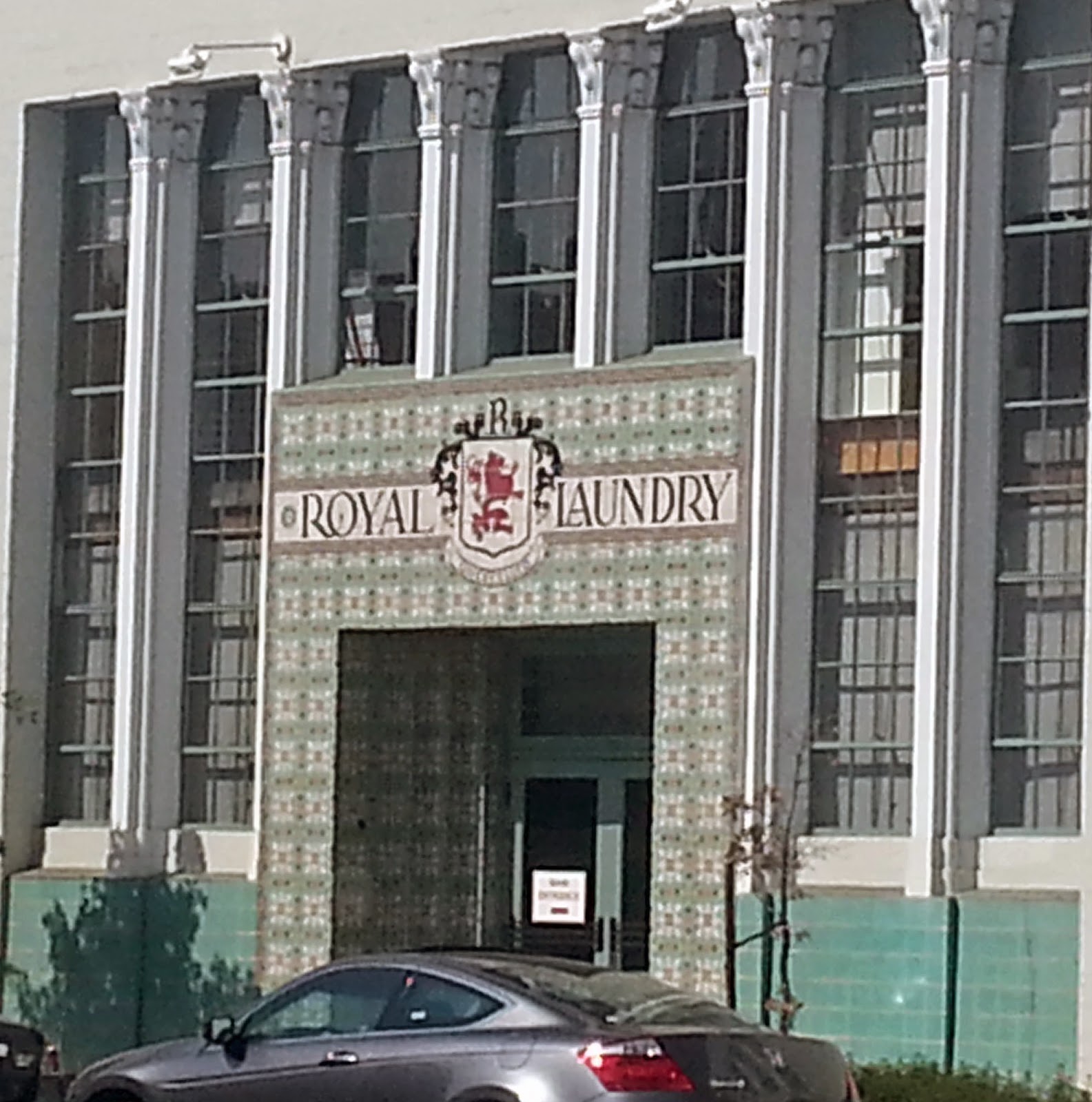
In the 1930 photo above, a delivery man poses with an American Austin coupe in front of the Royal Laundry complex at 443 S. Raymond Ave. at Bellevue Street.

Here is the original photo before I retouched it (badly) and cropped it:

Established in 1910 just down the street at 461 S. Raymond Ave., Royal Laundry catered mostly to luxury hotels and wealthy residents. By the mid-1920s, laundry services throughout the country were using the advanced technology of industrial machines for washing, drying and ironing, and Royal Laundry was no exception. 

The business moved to this new complex in 1927 designed by architect Gordon B. Kaufmann, who also designed Hoover Dam and the Athenaeum at Caltech. For this new complex, the façade and other exterior architectural elements were intended to represent the level of service, efficiency and cleanliness Royal Laundry provided. 

Here is a photo I took of the entrance yesterday:

Not long after, a drive-up service was added to the south of the main building to adapt to the increasing use of automobiles. Slightly raised lettering on the arrow that got painted over reads Drive-In & Save. This building in the complex now houses medical offices. When I was there yesterday, three or four Dial-A-Ride vans dropped off and picked up some elderly patients.


Royal Laundry closed in the 1980s and the complex sat empty for several years. To prevent demolition or major exterior changes, the main plant, drive-up building and annex building were listed in the National Register of Historic Places. 

During the years it was closed it was certainly not unused. Filming for several movies and TV shows took place there and the Backstreet Boys filmed their "As Long As You Love Me" music video there. 


Beginning in 2002 the building underwent a three-year historic preservation project and interior renovation after it was purchased, and then it was leased for the Disney Store worldwide headquarters.


Here is the exterior of the entire complex, looking south to north and then north to south:


The historic exterior of the complex now belies the modern, colorful, modular interior designed for Disney Store headquarters by Clive Wilkinson Architects to create a lively and inspiring workplace environment:


The historic ceiling is intact.

Oskar Mendez, a vinylmation character artist, is one of the 230 employees there. He's an Art Center College of Design grad.


See an interesting interview with Oskar, with even more photos, on the Disney Store blog.

This fun topiary, which cannot be seen from the street, frames part of a walkway between one of the buildings and the parking structure..


I wanted to capture some of the complex's exterior architectural elements yesterday:


The complex was sold two weeks ago. Will Disney Store worldwide headquarters stay? I certainly hope so. They signed a 13-year, $23 million lease agreement when they moved into the complex. Will that hold with the new owner? I'm not an attorney or a commercial real estate professional. We'll see.

P.S. -- John is correct that Royal Laundry was built on the site of the former Pasadena Grand Opera House. That's another story!  


I shot all the exterior color photos of the Royal Laundry complex with the exception of the topiary and the still of the music video. Additional photo credits: Huntington Library, Los Angeles Public Library, Backstreet Boys, Clive Wilkinson Architects, Colorcoat. Also, many thanks to my friend and former employee Gregg Guenthard, who is with the Petersen Automotive Museum, for identifying the vehicle.

Thursday, July 10, 2014

Mystery History -- Solved!

I stumped everyone this week, which means there will be an easier one next time (and then back to the head-scratching fun!).

In the circa 1920 photo above, an expert examines a specimen in a glass tube at an insectary owned by the Sierra Madre-Lamanda Citrus Association in Lamanda Park, which is now part of Pasadena.

Parasites propagated in the insectary's breeding room were used to kill insects that were infesting citrus groves.

Here is one of the labels placed on crates of oranges and lemons sent to destinations nationwide:


Icerya purchasi (common name cottony cushion scale) began infesting citrus groves in Los Angeles County in the 1880s. The early solution was to spray citrus groves heavily with sulphur and poisonous gases. By the early 1920s cottony cushion scale, native to Australia, threatened the future of the entire industry. The experiment with parasites was about as unsuccessful as the fumigation approach.

In desperation, citrus growers in Los Angeles and Orange, San Bernardino and Riverside counties teamed up and appealed to the U.S. Department of Agriculture in Washington, D.C.

In 1922 USDA entomologists and botanists went to work on an alternative solution and came up with the practice that is in use to this day nationwide: the propagation of rodolia cardinalis, commonly known as the vedalia beetle

As it turned out, the predatory beetles just loved gobbling up cottony cushion scale.


The first batches of beetles from the USDA laboratory were sent to insectaries that were in a position to propagate them for local distribution, and Lamanda Park's was one of them.

Cottony cushion scale could have destroyed the orange and lemon groves in Lamanda Park; a cousin of the ladybug saved them.

Here are some workers crating oranges in one of the Lamanda Park packing houses in 1923.


 A better look at that label:

See additional labels here.


Many thanks to the Library of Congress, Hometown Pasadena and Huntington Library.

Thursday, May 8, 2014

Mystery History -- Solved!


Bellis wins with her 8:36 p.m. Wednesday guess "These 1920s women are playing bridge with a robot who follows instructions phoned to him."

In the 1928 photo above, Herbert Televox the Mechanical Man, a robot developed by Westinghouse in 1927, plays bridge with three women in Pasadena by following telephonic voice commands during a nationwide publicity tour.

Televox with his inventor Roy Wensley.


See an article here from the January 1928 issue of Popular Science Monthly that goes into fascinating detail.

Westinghouse touted Televox as the housekeeper of the future.


I'm afraid Rosie beat him to the punch.


He also was considered the potential soldier of the future.

This is the only other Pasadena publicity photo I could find. I'll let it speak for itself!


Or perhaps you'd like to caption it. Leave your caption as a comment on this blog post. If I get more than one, I'll let the public decide which is the winner!


Photo credits: New York Times, Westinghouse Museum

Thursday, October 3, 2013

Mystery History -- Solved!

 
Karen wins with her 8:39 p.m. Tuesday guess "From the looks of that sago palm, I'm guessing it was a tea house at the Green Hotel?"
 
In Tuesday's post I cropped the photo, so here it is in full frame.
 
 
The Green Tea Pot was a restaurant in the 1920s inside the Hotel Green, now known as the Castle Green.

Unfortunately I couldn't find a photo of the café inside the hotel. But thanks to Pasadena Central Library, we do have some context by way of some articles in the Los Angeles Times.

Nov. 16, 1924:


Nearly $200,000 has been spent in remodeling the Hotel Green, famous Pasadena hostelry, and the Castle Green Apartments, adjoining that hotel, according to Charles B. Hervey, owner and manager of the Hotel Green. The hotel is now operated under the European plan the year around.

The Green Tea Pot Café is maintained in conjunction with the Green, offering excellent service. Mr. Hervey, who also is associated with F. W. Paget of San Diego in the management of the Maryland in that city, anticipates an unusually heavy business for the winter season.

Here's an ad in the L.A. Times on Feb. 27, 1925:

 
This item in the Oct. 20, 1926, edition of the L.A. Times is the first to indicate a name change:

CAFE ENLARGED

The Green Tea Pot, unique café of the Hotel Green in Pasadena, has been enlarged to double its former capacity, now seating 250. Henceforth, it will be known as the Colonial Café of the Green. The chef and crew of the Colonial Café of the Green (all women), formerly of the Samarkand of Santa Barbara, are serving dainty home-cooked foods. Chafing dish luncheons and Saturday evening dinner-dances are featured. Mr. Alfred Koch, former steward of the Samarkand, is in charge.

Jan. 12, 1927:

POPULARITY INCREASES

The new and enlarged Colonial Café of the Hotel Green in Pasadena is attracting many large luncheon and dinner parties. It is fast becoming the center of the social life of that section of Pasadena, according to Manager J. Manning Murfee. Dainty menus prepared by a trained crew of women cooks are featured.

There has not been a restaurant there in decades, but the ballroom of the Castle Green has been the site of hundreds of happy catered occasions.