Search This Blog

Saturday, January 25, 2014

Looking for Something To Do? Free Events Jan. 26 to Feb. 8

                 
By popular demand, I am reviving this feature that I posted every week when I was the Pasadena PIO. All events are free, and now that I'm retired I can also include events that are not sponsored by the City of Pasadena!

So take a look, and don't you dare tell me there's nothing to do in this town!

Pasadena Conservatory of Music's award-winning chamber music students will perform in concert Sunday, Jan. 26, at 4 p.m., in room 300F with works by Mozart, Haydn, Bridge, Mendelssohn, Clara Schumann and Pleyel.

Hill Avenue Branch Library presents "Złączym się z narodem: Poland, past and present" Thursday, Jan. 30, at 4 p.m. From the Baltic to the Tatras, Poland is filled with unique sights, sounds, and tastes that arise from its position between east and west and from a history that is simultaneously and by turns heroic,
tragic, comic and controversial. Explore the history and culture of Poland with Mark Kozłowski, a
2012-2013 Fulbright Fellow who lived and studied in Kraków, the ancient city of Polish kings.

Pasadena Central Library offers a film series at 1 p.m. every Wednesday with a different theme every month. This month it's films featuring Pasadena locales. The Jan. 29 film is the 1991 remake of "Father of the Bride" starring Steve Martin and Diane Keaton and filmed on South El Molino Avenue.

The Colorado Street Bridge will be closed to vehicular traffic Wednesday, Jan. 29, from 2 to 8 p.m. for the filming of a commercial for Ecolab. Detour plans will be in place and Pasadena police officers will assist with traffic control. Bicyclists and pedestrians will have access to the bridge, although they may be asked to stop briefly from time to time.

You don't have to be a member to attend Pasadena Senior Center's workshop titled Outlook and Opportunities Thursday, Jan. 30, at 10 a.m. Learn about trends that will help put your concerns about the economy into perspective. Explore the pace of recovery, deficits and debts, the economic outlook and strategies for addressing the impact of inflation and interest rates.

Draft policies for the City of Pasadena General Plan update will be reviewed at a community meeting Saturday, Feb. 1, at 9 a.m. in the Creveling Lounge (Building CC) at Pasadena City College. The policies cover topics such as growth, transportation, design, historic preservation, environmental sustainability, arts and culture, economic vitality, parking and education, and give direction for future planning efforts for several areas of Pasadena, including the Central District, East Pasadena, North Lake, Fair Oaks/Orange Grove, Lincoln Avenue, Washington/Allen, West Gateway and Northwest Pasadena.

Hastings Branch Library presents a special exhibit titled "Historical View of African American Families" from Feb. 1 to 28 during regular open hours. Explore the lives of families as seen through African American literature and the civil rights movement. This is just one of the Black History Month offerings throughout February in Pasadena.

Pasadena City College is asking our participation in a visioning community workshop Saturday, Feb. 8, from 9:30 to 11:30 a.m. in the Creveling Lounge at PCC. Help PCC President Mark Rocha, members of the Board of Trustees, staff and other PCC officials develop a future vision for the college and its facilities.

"Mr. Penumbra's 24-hour Bookstore" by Robin Sloan is Pasadena's 2014 One City, One Story selection. The popular community reading celebration was created in 2002 to nurture a love of books and spark vibrant discussions among residents. The New York Times said the book is "eminently enjoyable, full of warmth and intelligence. Sloan balances a strong plot with philosophical questions about technology and books and the power both contain." The novel is available for check-out Pasadena public libraries, for sale at Vroman's Bookstore and even available in eBook and Spanish options. So read"Mr. Penumbra's 24-hour Bookstore" and then get ready for a series of related activities and events in March including book discussions, film series, expert speakers and more throughout the month and a community dialog with the author Thursday, March 27

Thursday, January 23, 2014

Mystery Hstory -- Solved!


Bellis wins with her 4:12 p.m. Wednesday guess "The man in the apron looks Japanese, so I'll make a wild guess -- perhaps he's building the Storrier Stearns Japanese garden?"

In the circa 1937 photo above, Kinzuchi Fujii supervises the installation of sculpture at the Storrier Stearns mansion on Arlington Drive between Pasadena Avenue and Orange Grove Boulevard.

In 1935 Charles Storrier Stearns (1868-1944) and his wife Ellamae moved into the Georgian mansion built in the early 1900s. The property included extensive traditional gardens as well as grand tennis courts.


Here they are behind the house:


They were wealthy patrons of the arts, were active in the civic life of Pasadena and had the means to travel domestically and abroad. Swept by the wave of interest in Japonisme that was still taking Europe and the U.S. by storm, they went to Japan to purchase art, ceramics and textiles and fell in love with the gardens there. 

The rest of the story is a mix of triumph and tragedy, transitions and new beginnings.

Kinzuchi Fujii was born in 1875 in the Yamaguchi prefecter and came to San Francisco in 1903. A carpenter and craftsman by trade, he soon became interested in designing Japanese gardens for Americans of means and earned contracts as well as a sterling reputation in Hollywood, Ojai and Santa Barbara.

The Storrier Stearnses hired Fujii in 1935 to design and create a Japanese garden in place of the tennis courts, and construction began in 1937. 


He conceived of a vast garden with specific elements that would silently reveal themselves as people meandered along paths, over bridges, past ponds and waterfalls.

There was also a teahouse built in Japan to Fujii's specifications and shipped to L.A. for transport to Pasadena:  


 The Storrier Stearnses spared no expense as Fujii's vision came to life with black leaded tiles, stone ornaments, granite boulders, and plants and trees typical of Japanese woodland gardens. 


Fujii supervised the entire operation with the help of foremen and laborers, and he and Charles had great mutual respect for each other. 


The Japanese garden was nearly completed in 1941 when a series of terrible events took place: Japanese bombers attacked Pearl Harbor, the U.S. entered World War II and more than 100,000 people of Japanese descent were forced to relocate to internment camps -- including Kinzuchi Fujii*.

The final phase of the work had to be completed without Fujii's supervision, but the result was a marvel nonetheless and the Storrier Stearns were very happy with the Japanese garden on their property.,


After Ellamae passed away in 1949, the property was subdivided to be sold at auction.  Gamelia Haddad Poulsen (below), owner of Poulsen Galleries, attended the auction with the intention of buying some antique furniture from the mansion, but by the time she walked away she owned the entire Storrier Stearns estate.


Over the years she sold off most of the estate and the mansion was dismantled (one room is now part of the Pacific Asia Museum).

Circumstances dramatically changed again in 1975 when the State of California took the portion of the estate on the east side of the Japanese garden by eminent domain, along with many other properties on some other west Pasadena streets, to make way for the proposed 710 freeway.

Assuming the garden would be the next to be seized, Gamelia allowed it to deteriorate and sold off some of the artifacts. The teahouse was burned in 1981 and arson was suspected although an investigation was inconclusive.

When Gamelia passed away in 1985, her son and daughter-in-law, Jim and Connie Haddad, inherited it and they own it to this day.


Jim and Connie Haddad should achieve hero status in our community because they have restored the Japanese garden over time to its original condition.


The Storrier Stearns Japanese Garden is is at 270 Arlington Dr., across the street from Arlington Garden. It is open to the public the last Sunday of every month from 10 a.m. to 4 p.m. The cost is $7.50 and children 12 and under are free. Make your reservation online here.


* What ever happened to Kinzuchi Fujii? In the one suitcase the government allowed him to take to the internment camp, he carried his original plans for the garden and several photos of the work in progress. After Japanese Americans were released from the camps, his whereabouts become unknown. He never saw his masterpiece again.

UPDATE FROM BELLIS: "I did hear on a tour of the gardens that someone connected with the Haddads ran into Kinzuchi Fujii's son quite by chance in a San Diego restaurant. He said his father moved to San Diego after internment and was so upset by the way he had been treated that he couldn't bear to to visit the garden again."


Many thanks to the Storrier Stearns Japanese Garden and the Pasadena Museum of History.

Tuesday, January 21, 2014

Mystery History


Where are we? And what's happening?

The first person to guess correctly will win lunch with me -- I'll buy yours and you'll buy mine.

Remember, leave your brief guess as a comment on this blog post but don't try to give the entire back story (that's my job).

I'll have the full scoop on Thursday.

Friday, December 20, 2013

Mystery History -- Solved!


Karen wins with her 3:57 p.m. guess "Looks like someone dressed as Aladdin, Ali Baba or Sinbad contemplating the place where he will sit on a Rose Parade float, which hasn't been covered with flowers yet."

In the Jan. 2, 1933, photo above, a young man in an east Indian or middle eastern costume (it's hard to tell) covers a seat on a float for the 44th Rose Parade.

Unfortunately I couldn't find which float it was. The photo description simply states, "Young man in costume constructing a Tournament of Roses Float, Pasadena, 1933." Of course he wasn't constructing the float -- he was doing some finishing touches.

There are photos of some of the 1933 floats and dignitaries here.

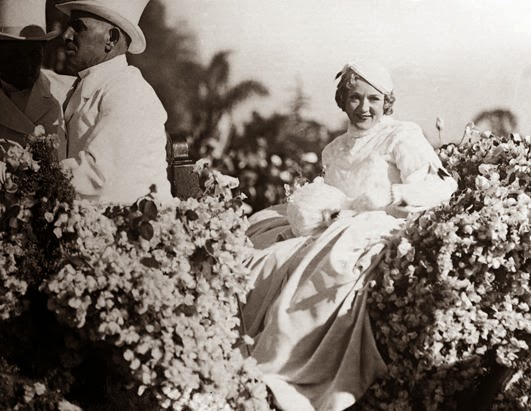
The theme of the parade that year was Fairy Tales in Flowers. Mary Pickford was the grand marshal -- the first woman to be selected for this honored role. . .


. . .and Dorothy Edwards (sitting at top) was the Rose Queen.


The parade making its way down Colorado Boulevard:


Fast forward 81 years and the theme of the Jan. 1, 2014, Rose Parade is "Dreams Come True."

Vin Scully will be the grand marshal (which means he'll also toss the coin at the opening of the Rose Bowl Game). . .


. . .and the Rose Queen is Anna Marie Acosta (center).


Do you have your tickets?!

Oh, and be sure to stop by one of the float-decorating areas to see the flowers and other plant materials being painstakingly put on by hundreds of volunteers.

Do you know there was one year when the Rose Parade was canceled? On Dec. 14, 1941 -- one week after the bombing of Pearl Harbor -- it was decided that the 1942 Rose Parade would not take place for reasons of national defense and civilian protection. The Rose Bowl Game, between Duke and Oregon State, was played on the opposite side of the country in Durham, N.C. The streets of Pasadena must have been eerily quiet that day.

On Jan. 1, 2012, it was the thrill of a lifetime when I rode on the Kiwanis International float in the Rose Parade thanks to my wonderful friends.


Tuesday, December 17, 2013

Mystery History


Where are we? And what's happening?

The first person to guess correctly will win lunch with me -- I'll buy yours and you'll buy mine.

Remember, leave your brief guess as a comment on this blog but don't try to give the entire back story (that's my job).

I'll have the full scoop on Thursday.

Saturday, November 23, 2013

Farewell, Erika...


Erika, you passed away at 2:50 p.m. yesterday. Your sister Emily said the Moore Brothers' Now Is the Time for Love was playing.

You had been on life support since Sunday when you were discovered unconscious at home. None of us could grapple with the fact that an unexpected, deadly issue had been lurking, silently and undetected, before it struck you down in the blink of an eye.

How can it be that our vibrant, beautiful friend is gone? Our hearts are broken.


You were so creative in every aspect of your life, from fashion to art. At an early age you discovered through photography that you could see the world and light in a whole new way.

You earned a degree in photography from the prestigious Art Center College of Design in 1995. Your works can be found in galleries and private homes, as well as in the books Greene & Greene: The Passion of the Legacy by Randell Makinson and Greene and Greene by Edward Bosley.


You were among the guests at my retirement party in 2012. We had such a wonderful time that night at the Castle Green! I love this photo of you swing dancing with Ed Razor:


You were crowned queen of the Pasadena Doo Dah Parade in 1999. Here you are (center) with some other former queens at the 2013 parade -- Kavita Sharma, Rosie SchoenMichelle Mills and Dianne Patrizzi.


A child is never supposed to precede her parents in death. It's just not the way the universe is intended to work. But you did, leaving behind your mother Janeen Marrin, your father Jim Marrin, your sister Emily and her children Lucy and Leo whom you adored so much.

It seemed nothing could separate you and your dad. . .until now.


Last night when a few friends gathered with Jim, Janeen and Emily to hold them close, I leafed through this book that was on the dining table. It brought me a sense of comfort.


Some time ago you opted to be an organ donor. So you have given the ultimate gift of hope to a half dozen people who will live longer and fuller lives because of your selfless generosity. They and their families will be forever grateful.


Farewell, Erika. It was my honor and privilege to know you. 


 This is not the end; you will live on in our hearts and minds.


Photos are from Kavita, Erika's Facebook page and my own archives.

Thursday, November 7, 2013

Mystery History -- Solved!


Liz wins with her 6:28 p.m. Tuesday guess "Building the Green and Green Gamble house on Orange Grove."

David Berry Gamble, the son of Proctor & Gamble co-founder James Gamble, commissioned architects Charles and Henry Greene to design a home in Pasadena that would become a permanent residence where he would live out his days with his wife Mary.

They lived in Cincinnati where Gamble had taken over the reins at Proctor & Gamble years before, retiring in 1895 and spending several winters at Pasadena resort hotels. In 1907 David and Mary purchased a lot on Westmoreland Place along "Millionaires Row"; Greene & Greene completed the design of The Gamble House  in February 1908 and ground was broken the following month.

Charles (left) and Henry Greene:

Here's an invoice from the builder:

 
The completed house -- view from the north:

 
Gardens:

 
One of the terraces:


By summer 1910 the custom-designed furniture, artfully executed metalwork, luminous art glass windows and light fixtures were in place.


The coolest staircase ever:


After David passed away in 1923 and Mary in 1929, the house was occupied solely by Mary's sister, Julia Huggins. Following her death in 1946, Cecil and his wife Louise moved into the house and made plans to sell it.

When they learned the prospective buyer planned to paint all of the interior teak and mahogany woodwork white, they put a halt to the sale. They were well aware of the historic and artistic significance of the house and decided to keep it in the family.

Twenty years later the Gambles deeded the house to the City of Pasadena, which owns it to this day*; it is managed by the USC School of Architecture.

The Gamble House today:


The Gamble House is a national historic landmark and the only one of the Greenes' works open to the public. All of the original furnishings and fixtures designed by the architects remain in place. 

The Gamble House is open for regularly scheduled and special tours, all led by docents. Note to women planning to wear heels: Don't do it! You'll be required to take them off and don unattractive booties to preserve the wood flooring.

And the bookstore in the original garage is a must-visit!

* The City of Pasadena owns several other high-profile properties, including the Wrigley Mansion, the former National Guard armory occupied by Armory Center for the Arts and the lands on which the Norton Simon Museum and the Pasadena Senior Center are located.


Many thanks to the Greene and Greene Archives at Huntington Library, Art Collections and Botanical Gardens and the Gamble House.
 

Tuesday, November 5, 2013

Mystery History

 
Where are we? And what's happening?
 
The first person to guess correctly will win lunch with me -- I'll buy yours and you'll buy mine.
 
Remember, leave your brief guess as a comment on this blog but don't try to give the entire back story (that's my job).
 
I'll have the full scoop on Thursday.

Friday, November 1, 2013

Mystery History -- Solved!


Loren wins with his 8:40 a.m. Tuesday guess "Well, there was a Thrifty on Colorado down close to City Hall, right? So it could be an anti-littering ad campaign that was shot on Colorado."

The April 11, 1955, newspaper photo above from The Independent is captioned "The litterbug in action." Of course the photos were staged.

Here's another photo from the article:


The Independent conducted what's now called an eyeball survey -- a reporter stood at various locations on Colorado Boulevard and observed.

Here's the article:

The litterbug nuisance along Pasadena streets, which has brought complaints
from many citizens here, was traced in part to the city's sparing use
of trash receptacles, in a survey conducted by The Independent.
 
Citizen indifference was a big factor, however. Some downtown strollers
were observed taking a dozen steps to drop empty cigarette packets in gutters,
when they were within three steps of a trash receptacle.
 
Citizens who were both lazy and indifferent failed to make the gutter.
They dropped papers underfoot on the sidewalk.
 
Some conscientious strollers carried crumpled up waste paper
for a block, looking in vain for a trash can. Some looked furtive
and conscience-stricken as they finally flicked their problem into the gutter.
 
City health officials have warned many times that accumulated
food wrappers, peelings and sandwich bits, lately standard items
along Pasadena's streets, are tempting come-ons for rats,
which grow fat and multiply when food is conveniently left out for them.
 
Rats aren't the only animals that forage for their food. Dog packs,
stray cats, insects, vermin, all head for the cast-off piles in the gutters.
 
In one block east of Allen Avenue, there are more mail boxes than trash boxes.
 
Another constant source of street litter is the outdoor eating places
and drive-in restaurants in some locations where careless eaters toss refuse to the winds.

I imagine the desks of city officials were littered with complaints about litterbugs at the time!

In modern times there is a trash receptacle at just about every block -- one at every bus stop.

There are also more than 40 of these Big Belly solar-powered trash compactors around town:


Leadership Pasadena brought a proposal for the compactors to the Public Works Department in 2007 as a possible environmental project, which led to a pilot program with four placed at key locations, followed by the Pasadena City Council approving the purchase of 36 more in 2009.

They take up as much space as ordinary trash receptacles but have five times the capacity and compact the trash using the power of the sun.

So note to those 1955 litterbugs: You have no excuse 58 years later!