Search This Blog

Showing posts with label 1930s. Show all posts

Thursday, November 13, 2014

Mystery History -- Solved!

I stumped everyone this week, which means the next Mystery History will be easier.

In the 1935 photo above, Joseph Barry (left), J. Louis Comiskey (center) and Harry Grabiner sit on an arroyo stone wall at Brookside Park while the Chicago White Sox play a baseball game during spring training.

From 1933 to 1942 and from 1946 to 1950, the Chicago White Sox had their spring training right here in Pasadena at Brookside Park.

(For those who guessed it was William Wrigley Jr. in the photo, he owned the Chicago Cubs and the team had its annual spring training on Catalina Island, which he owned.)

Joseph Barry was the White Sox traveling secretary, J. Louis Comiskey was owner and president of the White Sox organization and Harry Grabiner was vice president.

Every one of the dozens of photos shot by a Pasadena Post photographer three years later, on March 9, 1938, is damaged in one way or another but thankfully now they are carefully stored in the Centennial Room at Pasadena Central Library.,

The White Sox catching and throwing along the sidelines at Brookside Park as spectators look on:


Team members lining up in front of a movie camera for a newsreel that would be shown in theaters (people of my generation know what that means!).


Here is a 1942 article in the Chicago Tribune:


See the rest of the article, including photos, by clicking here.


Many thanks to Baseball Fever, Pasadena Public Library and Chicago Tribune.

Thursday, September 18, 2014

Mystery History -- Solved!


I stumped everyone this week. See what happens when you don't see an exhibition at Pasadena Museum of History?

I shot this photo straight from the wall in the north gallery, where the exhibition Crown City Jubilee celebrated institutions in Pasadena's history. One section was about schools and included the photo above. The exhibition opened in May and closed on Sept. 14.

In this 1934 photo, Hazel Barker's sixth grade class at Ulysses S. Grant School poses with the telephone system they designed and built for the school. 

In the 1930s Grant School was designated as a school for gifted students, so it's not surprising in this city famous for science and engineering that these young smarties were given such a project.

Grant school, which no longer exists, was originally located on a portion of 18 acres on Colorado Boulevard between Hill and Sierra Bonita avenues set aside for construction of a new campus for Pasadena High School. See this 2011 Mystery History post for a little more about that.

I've had a lot going on lately and have been extraordinarily busy, so I didn't have time to fish through the Pasadena Museum of History archives for additional photos of Grant School. The good news is this leaves the door open for another Mystery History photo about Grant School someday!


Many thanks to Pasadena Museum of History.

Thursday, July 24, 2014

Mystery History -- Solved!

Daniel wins with his 8:24 p.m. Tuesday guess "Colorado Street Bridge, temporary suicide prevention fence - sometime in the 1930's."

In the Aug. 9, 1937, noir-esque photo above, a man pauses to look through the tall, chain link suicide prevention fence topped with barbed wire on the Colorado Street Bridge. It was the first such barrier ever installed on the bridge.

Here's the full image:

The cutline (photo caption) in the Los Angeles Herald Tribune includes this sentence: "The new fence will not detract from the span's beauty."  It was almost immediately decried as an eyesore. 

The bridge, constructed in 1913, stands nearly 150 feet tall, spans nearly 1,500 feet across the Arroyo Seco and has been the site of several suicides over the years, earning it a regrettable nickname.

The first person to leap to his death was in 1915. The predominance of jumpers -- nearly 100-- took the plunge during the Great Depression between 1929 to 1939. Almost all of the jumpers were from Los Angeles.

These photos show the Colorado Street Bridge before the suicide prevention fence was installed. There was only a chest-high balustrade.

As with all the suicides during the Great Depression, the one just prior to the installation of the ugly fence was a sad and tragic case.

Myrtle Ward and her musician husband lived in the El Sereno district of Los Angeles with their 3-year-old daughter Jeannette. Like so many others, they were out of work and the financial burdens were becoming more crushing with every passing day. Myrtle lost all hope and became despondent.

On the morning of May 1, 1937, 22-year-old Myrtle drove the family car to the east end of the bridge, got out and, holding little Jeannette's hand, went onto the bridge's pedestrian walkway. Myrtle stepped onto a bench in a little alcove at the highest point of the bridge and threw little Jeannette over the side. She then climbed onto the short balustrade and jumped to her death.

Jeannette's fall was broken by a tree branch before she landed on a small spot of soft sand in the Arroyo Seco streambed.

Myrtle died three days later at Huntington Memorial Hospital; Jeannette was hospitalized briefly and was raised by her paternal grandmother.

In 2011 the Pasadena Weekly ran an article about then 77-year-old Jeannette titled "Heavenly Helpers." It included this quote from her:

“God sent his angels down there and saved me. 
There was no other explanation. . .It was not my day to die.”

That very first fencing in the top photo was installed shortly after the May 1 incident.

When the Colorado Street Bridge made its second debut in 1993 after a nearly four-year seismic retrofit and historic restoration project, it included a suicide prevention barrier complementary to the bridge's architecture and surroundings that remains to this day.

In modern times the number of suicides committed at the bridge averages less than two a year. That's still too many, but it's a much better number than the 10 a year during the Great Depression.

Pasadena police officers and chaplains respond to calls at the bridge a few times a year. Ordinarily they are successful in convincing people not to jump.


Many thanks to Los Angeles Public Library, Southern California Daily Photo and Lins Consulting

Thursday, January 23, 2014

Mystery Hstory -- Solved!


Bellis wins with her 4:12 p.m. Wednesday guess "The man in the apron looks Japanese, so I'll make a wild guess -- perhaps he's building the Storrier Stearns Japanese garden?"

In the circa 1937 photo above, Kinzuchi Fujii supervises the installation of sculpture at the Storrier Stearns mansion on Arlington Drive between Pasadena Avenue and Orange Grove Boulevard.

In 1935 Charles Storrier Stearns (1868-1944) and his wife Ellamae moved into the Georgian mansion built in the early 1900s. The property included extensive traditional gardens as well as grand tennis courts.


Here they are behind the house:


They were wealthy patrons of the arts, were active in the civic life of Pasadena and had the means to travel domestically and abroad. Swept by the wave of interest in Japonisme that was still taking Europe and the U.S. by storm, they went to Japan to purchase art, ceramics and textiles and fell in love with the gardens there. 

The rest of the story is a mix of triumph and tragedy, transitions and new beginnings.

Kinzuchi Fujii was born in 1875 in the Yamaguchi prefecter and came to San Francisco in 1903. A carpenter and craftsman by trade, he soon became interested in designing Japanese gardens for Americans of means and earned contracts as well as a sterling reputation in Hollywood, Ojai and Santa Barbara.

The Storrier Stearnses hired Fujii in 1935 to design and create a Japanese garden in place of the tennis courts, and construction began in 1937. 


He conceived of a vast garden with specific elements that would silently reveal themselves as people meandered along paths, over bridges, past ponds and waterfalls.

There was also a teahouse built in Japan to Fujii's specifications and shipped to L.A. for transport to Pasadena:  


 The Storrier Stearnses spared no expense as Fujii's vision came to life with black leaded tiles, stone ornaments, granite boulders, and plants and trees typical of Japanese woodland gardens. 


Fujii supervised the entire operation with the help of foremen and laborers, and he and Charles had great mutual respect for each other. 


The Japanese garden was nearly completed in 1941 when a series of terrible events took place: Japanese bombers attacked Pearl Harbor, the U.S. entered World War II and more than 100,000 people of Japanese descent were forced to relocate to internment camps -- including Kinzuchi Fujii*.

The final phase of the work had to be completed without Fujii's supervision, but the result was a marvel nonetheless and the Storrier Stearns were very happy with the Japanese garden on their property.,


After Ellamae passed away in 1949, the property was subdivided to be sold at auction.  Gamelia Haddad Poulsen (below), owner of Poulsen Galleries, attended the auction with the intention of buying some antique furniture from the mansion, but by the time she walked away she owned the entire Storrier Stearns estate.


Over the years she sold off most of the estate and the mansion was dismantled (one room is now part of the Pacific Asia Museum).

Circumstances dramatically changed again in 1975 when the State of California took the portion of the estate on the east side of the Japanese garden by eminent domain, along with many other properties on some other west Pasadena streets, to make way for the proposed 710 freeway.

Assuming the garden would be the next to be seized, Gamelia allowed it to deteriorate and sold off some of the artifacts. The teahouse was burned in 1981 and arson was suspected although an investigation was inconclusive.

When Gamelia passed away in 1985, her son and daughter-in-law, Jim and Connie Haddad, inherited it and they own it to this day.


Jim and Connie Haddad should achieve hero status in our community because they have restored the Japanese garden over time to its original condition.


The Storrier Stearns Japanese Garden is is at 270 Arlington Dr., across the street from Arlington Garden. It is open to the public the last Sunday of every month from 10 a.m. to 4 p.m. The cost is $7.50 and children 12 and under are free. Make your reservation online here.


* What ever happened to Kinzuchi Fujii? In the one suitcase the government allowed him to take to the internment camp, he carried his original plans for the garden and several photos of the work in progress. After Japanese Americans were released from the camps, his whereabouts become unknown. He never saw his masterpiece again.

UPDATE FROM BELLIS: "I did hear on a tour of the gardens that someone connected with the Haddads ran into Kinzuchi Fujii's son quite by chance in a San Diego restaurant. He said his father moved to San Diego after internment and was so upset by the way he had been treated that he couldn't bear to to visit the garden again."


Many thanks to the Storrier Stearns Japanese Garden and the Pasadena Museum of History.

Friday, December 20, 2013

Mystery History -- Solved!


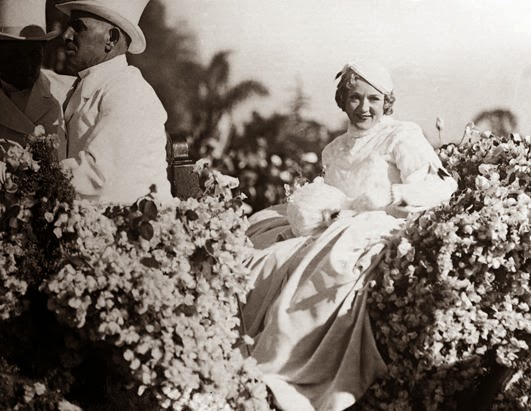
Karen wins with her 3:57 p.m. guess "Looks like someone dressed as Aladdin, Ali Baba or Sinbad contemplating the place where he will sit on a Rose Parade float, which hasn't been covered with flowers yet."

In the Jan. 2, 1933, photo above, a young man in an east Indian or middle eastern costume (it's hard to tell) covers a seat on a float for the 44th Rose Parade.

Unfortunately I couldn't find which float it was. The photo description simply states, "Young man in costume constructing a Tournament of Roses Float, Pasadena, 1933." Of course he wasn't constructing the float -- he was doing some finishing touches.

There are photos of some of the 1933 floats and dignitaries here.

The theme of the parade that year was Fairy Tales in Flowers. Mary Pickford was the grand marshal -- the first woman to be selected for this honored role. . .


. . .and Dorothy Edwards (sitting at top) was the Rose Queen.


The parade making its way down Colorado Boulevard:


Fast forward 81 years and the theme of the Jan. 1, 2014, Rose Parade is "Dreams Come True."

Vin Scully will be the grand marshal (which means he'll also toss the coin at the opening of the Rose Bowl Game). . .


. . .and the Rose Queen is Anna Marie Acosta (center).


Do you have your tickets?!

Oh, and be sure to stop by one of the float-decorating areas to see the flowers and other plant materials being painstakingly put on by hundreds of volunteers.

Do you know there was one year when the Rose Parade was canceled? On Dec. 14, 1941 -- one week after the bombing of Pearl Harbor -- it was decided that the 1942 Rose Parade would not take place for reasons of national defense and civilian protection. The Rose Bowl Game, between Duke and Oregon State, was played on the opposite side of the country in Durham, N.C. The streets of Pasadena must have been eerily quiet that day.

On Jan. 1, 2012, it was the thrill of a lifetime when I rode on the Kiwanis International float in the Rose Parade thanks to my wonderful friends.


Thursday, February 14, 2013

Mystery History -- Solved!


I'm calling a tie between Wanda and Davis -- Wanda for coming pretty close with the 8:30 a.m. Tuesday guess "The word Pyrex suggests that the subject is glass; could it be a clock tower face? Something to do with a lens at Cal Tech or PCC? Looks like the 1930s..."'

And Davis also wins for pretty much nailing it at 9:38 a.m. Tuesday guess "Looks like it could be a mirror for a telescope; Mt. Wilson, maybe?" followed five minutes later with "Too big (and too late) for Wilson; make it the Hale Telescope for Palomar."
  
This week's prize is lunch with yours truly, so Wanda, contact me next time you're in town; Davis, e-mail me at annerdman.ladyofleisure@gmail.com and we'll make a date!

In the photo above, with throngs of people watching, a Pyrex telescope disc 200 inches in diameter, weighing 20 tons and made by the Corning Glass Company, is offloaded from a rail car in Lamanda Park on April 10, 1936, so it can be transported by truck to the optical lab at Caltech.

Because the disc was so heavy and yet very delicate, the train trip from upstate New York to Pasadena took weeks at a top speed of 25 miles per hour.

The disc was greeted by a contingent that included Edwin Hubble, the man on the far right in this group:

 
It was actually transported to Caltech by two trucks -- one pulling, one pushing:
 
 
At Caltech it would undergo more than a decade of painstaking grinding and polishing before being transported to its final destination: the Palomar Observatory in north San Diego County.

Why did it take so long? Delays were caused during World War II.

Led by George Ellery Hale, the Palomar Observatory telescope project began in 1929 with a $6 million grant from the Rockefeller Foundation. Hale had hoped engineers at General Electric could create a disc from fused quartz. After unsuccessful attempts with GE, in 1932 Hale turned to scientists at Corning who believed their Pyrex borosilicate glass could meet his requirements.

The Pyrex disc had only a rough, flat front surface. Here is a photo of men at the Corning Glass Works pouring molten Pyrex:


Pyrex does not expand or contract due to shifts in temperature, so Hale knew this would be a winner for Palomar Observatory, which sits atop Palomar Mountain and experiences weather shifts ranging from snowy cold in winter to brutal heat in summer.


Here you can see a 102-inch grinding tool at Caltech smoothing the rough Pyrex surface:


And here is the finished product 13 years later -- the beautifully refined telescope mirror, polished to an accuracy of two-millionths of an inch.


Over the years, the Hale Telescope at Palomar helped scientists verify dozens of theories, including the fact that quasars are extremely powerful yet distant objects, and that the universe is expanding, as Hubble had theorized.

Corning has a nice history of the project, including additional photos, here.

The blog Palomar Skies was started by the observatory's director of public affairs and ran until July when he left for another job.

Toward the end of lis life, George Ellery Hale is said to have looked up at the sky and rejoiced, “It is a beautiful day. The sun is shining and they are working on Palomar.” He would not live to see that telescope finished, but it was named for him.

It was the largest telescope in the world for nearly 45 years until 1993 when the Subaru telescope, whose mirror was also made by Corning, was launched in Hawaii.


Many thanks to Caltech, which owns and operates the Palomar Observatory, and to Corning Glass Company.