Search This Blog

Showing posts with label Ann's Family. Show all posts

Friday, August 11, 2017

I Was an Early Learner


One of my earliest childhood memories in the early 1950s is sitting in my mother's lap, my head resting against her chest, as she read me "The Story of Babar the Little Elephant" with all those colorful illustrations. It was one of my favorite books at the time. The rocking chair whispered a soft, familiar creak as it went gently back and forth.

I don't know if she was aware of the long-lasting benefit to this little girl of that simple moment and so many others like it.

Well, perhaps she was.

Here she is in 1930 with her mother, my beloved maternal grandma. See anything significant?


When I was growing up, our household was filled with music, literature, board games, family discussions during breakfast and dinner and so many other activities. As my siblings and I grew a little older, I constantly leafed through the Encyclopedia Britannica and the Book of Knowledge that had places of honor among the many crowded bookshelves in our home. We were so fortunate to have parents who instilled in us a lifelong love of learning.


A generation later, I created moments of my own with my first-born daughter Becky and youngest daughter Jessica by reading to them and later with them, beginning with picture books when they were infants, nursery rhymes as toddlers and so many wonderful children's books in their elementary years. 

By the time they were in high school in the 1980s and no longer at home for long hours at a time, we sometimes shared the same book, each of us reading a chapter or two and then passing it on to the other two as they took their turns. No spoilers were allowed, so we continued trading off, little by little, until we each finished the last word in the last chapter of a novel. Only then did we discuss and critique the book in enthusiastic detail (Mario Puzo's "The Sicilian" immediately comes to mind).


As my children's mother, this all came naturally to me, I think, because of the environment in which I was raised and the special traditions my family had when I was growing up.

But not all parents have similar memories and experiences.

This is exactly the purpose an exciting and important new movement I am pleased to be part of: Pasadena as an Early Learning City. It's all about the importance of parents and other caregivers reading, talking, singing and playing with young children from infancy to age 5.

Why? Because study after study over the course of decades has proven the first five years of life are crucial in the development of a child's brain, one of very few organs that is not fully formed at birth. This is the reason young children learn more quickly and retain more information than at any other times in their lives. 

It's why a young child can learn a second language so easily while an adult often struggles with it, why a young child can learn to read so much more easily than a previously non-reading adult in a literacy class and why a young child is so much more imaginative with, say, a couple of blocks than an adult who simply sees an object for what it is. 

Are you connecting the dots yet? 


When parents and other caregivers engage in positive ways with children -- by singing, reading, talking and playing -- beginning at infancy and continuing through age 5 at a minimum, those children develop skills that impact their future ability to learn as well as their social, emotional and physical well-being.

Sounds simple, right?

So why is it that six of 10 children nationwide who enter kindergarten are already behind when they walk in the door their first day of school, leading to a cycle of remedial catch-up that can last for years?

For the answer, let's go back to those parents who are overwhelmed or poorly educated or not aware of the incredible resources for parents and young children in Pasadena.

The Pasadena as an Early Learning City movement will create meaningful, collaborative relationships among all those resources, build awareness of them and create easy access to them. Parents will become empowered to make use of these programs and build their own skills while staying connected to local resources and opportunities.

What can you do?

Come to a very special community event Saturday, Sept. 23, from 9 a.m. to 1 p.m. at Brookside Park where there will be children's activities for different age groups, healthy cooking demonstrations by celebrity chefs Jet and Ali Tila, arts and crafts, entertainment, healthy snacks, oodles of information about resources for parents of young children and much more.

This will be the big kick-off but it won't end there. The goal is to make Pasadena renowned as an Early Learning City by 2025. This movement is spearheaded by the City of Pasadena Office of the Young Child. 


Several months ago I was asked to serve on the Pasadena Council for the Young Child, which provides support for the Office of the Young Child. The council, chaired by Dr. Vera Vignes, is a coalition of local experts in early learning, health care, education, social services and other related fields. I have been happy to bring my 40+ years of communications experience to the effort. It is such a pleasure to work with so many people I know well and get to know others better. 
The City of Pasadena Office of the Young Child is led by Lila Guirguis, who formerly was with First 5 LA. You can learn more about this office by clicking on the link two paragraphs up, which will take you to a Facebook page. Once you get there and start poking around, be sure to click on "About" on the left side of the screen to learn how the office was established and why it matters. 

Lila will have her hands full with her many duties, not the least of which will be cross-coordinating the many resources in Pasadena that serve our youngest children and their parents -- from city departments to schools to nonprofits -- so they will begin to work collaboratively as the Pasadena as an Early Learning City movement proceeds into the future.

I hope to see you on Sept. 23! 

Thursday, April 6, 2017

The Great War: A Centennial Milestone

One hundred years ago today, the U.S. entered World War I, which impacted my family (I'll get to that in a minute).

The Great War, as it was known then, began in Europe on July 28, 1914. Headlines in American newspapers roared with daily news of the fighting that began with an international diplomatic crisis: the murder in Sarajevo one month before of the Austro-Hungarian Empire's Archduke Franz Ferdinand by a Bosnian Serb assassin against a backdrop of escalating tensions in the Balkans. Franz Ferdinand was the much reviled nephew of Austro-Hungarian Emperor Franz Josef and heir to the throne. 


Following the assassination, the resulting attempts at diplomacy were bungled to such an extent that the impacts of the incident escalated all over Europe. Battle lines were drawn between the central powers of Austro-Hungary, Germany, Bulgaria and the Ottoman Empire and the allied powers of France, England and Russia. The Austro-Hungarian Empire declared war on Serbia on July 28, Germany declared war on Russia on Aug. 1, Germany declared war on France on Aug. 3 and Britain declared war on Germany on Aug. 4. The world would never be the same.

Americans paid attention to the conflicts through newspapers, magazines and the relatively new medium of silent newsreels, but this was not our war.

On May 7, 1915, a German U-boat torpedoed the British ocean liner RMS Lusitania in the Atlantic Ocean off the southern Irish coast. Among the 1,100 passengers who perished, 128 were Americans.


But that was not the impetus for the U.S. inserting itself in a foreign war. More than two years would pass before that happened.

In January 1917, British intelligence intercepted a telegram, written in coded numbers, sent from Germany’s foreign secretary to the German ambassador in Mexico City. It conveyed specific instructions: Germany would finance a major attack on the U.S. by Mexican troops, and Mexican diplomats would serve as intermediaries to persuade Japan to join the German cause. In exchange, Germany would help Mexico reclaim Texas, Arizona and New Mexico.

Britain provided a decoded transcription of the telegram to U.S. intelligence officials who shared it with President Woodrow Wilson. 
America had a progressive policy of neutrality, and Wilson was not ready to reverse that approach.

On Feb. 3, 1917, German U-boats sank the American steamer Housatonic in the Atlantic Ocean near the south coast of England. By late March, U-boats had sunk four U.S. merchant vessels in the Atlantic Ocean near the British Isles, the North Sea and the coast of France. 

President Wilson could wait no longer. On April 2, 1917, he addressed a special session of Congress with his "The world must be made safe for democracy" speech. Three days later, Congress voted its approval for a declaration of war against Germany, and on April 6 President Wilson signed the joint resolution. Newspaper headlines across the nation that evening and the following morning were too large to ignore:

Young American men from sea to shining sea enlisted in the war effort at the rate of 10,000 troops a day. Many of them were deployed to France on the Western Front, where allied soldiers fought ferociously in the trenches. The allied troops needed all the help they could get against Germany at Cantigny, Belleau Wood, Château-Thierry and other battlefields. 

To instill patriotism in every red-blooded American and encourage men to register for the draft, the federal Committee on Public Information was established by presidential executive order to produce press releases, songs, newsreels, posters, pamphlets, you name it. It was a big propaganda machine of sorts, and it worked. The most famous song to come out of this effort was the iconic "Over There" written by George M. Cohan. It was on the lips of every person in the U.S. from 1917 to the end of the war. 

My beloved paternal grandfather, Jess Harper Easley, registered on June 5, 1917. He was 26 years old.


Once he was called to duty, he served in France on the Western Front for just over a year at Belleau Wood and Château-Thierry. He came home in one piece, thankfully. 

This photo of American troops at Hill 24 at Belleau Wood is in the National World War I Museum: 

When my grandfather returned to the U.S., Camp Mills on Long Island in New York was his temporary base for about a month. He communicated with his mother, my great-grandmother, via telegram.

I have added punctuation here.

Camp Mills NY 10:27 a.m. Dec. 4, 1918
Mrs. May Easley
Lebanon, Mo.

Got your wire this morning. Also money from Peter. The best I can find out is will be going home in one or two weeks. Make Beulah* stay. Am wiring Joe** and will bring him if I can expect to see some of New York.

J H Easley

World War I was one of the bloodiest wars in history. By the time it was over, there were 36.5 million military and civilian casualties: 16.5 million deaths and 20 million people injured. And it all started with the assassination of a second-rate, greatly rebuked despot in waiting. 

When will they ever learn?

Boundaries in Europe and names of countries changed dramatically after the war ended.


Do you know there is a World War I memorial right here in Pasadena? If you live here, you no doubt have passed it many times at the northeast corner of Colorado Boulevard and Orange Grove. I wrote a blog post about it when I was the Pasadena PIO and included a lot of photos.

I am grateful to my late father, David Edward Easley, for instilling in me a love of history. I have no doubt he developed his love of history thanks to his father, Jess Harper Easley. Like father, like son:


There are dozens of additional layers to the story of America's involvement in World War I. But hey, I'm writing a blog post here, not a textbook. 

You can get a crash course in all those layers in this nifty, informative video.


* My grandaunt Beulah Easley was visiting their hometown of Lebanon, Mo., from Redondo Beach, Calif., where she and her husband lived and owned a bakery. I blogged about the remarkable adventures of Beulah in her younger days in this post. (Rail rider! Harvey Girl! Independent spirit!)

** My granduncle Joseph (Joe) Easley had recently moved to New York City to make his way as a professional illustrator and cartoonist. It would not be long before his career would take off. He freelanced for Collier's, Saturday Evening Post and Railroad Magazine, as well as for some corporate clients, from 1918 to 1971. Most of that time he lived on Staten Island. There's a nice little piece about him here, one in a series of profiles about Staten Island artists.


Photo credits: Austrian National Library, New York Times, U.S. National Archives and Records Administration, University of Missouri, Easley Family Archives, National World War I Museum, BBC.

Tuesday, October 18, 2016

Wait, Wait -- Follow the What to Where?

I snapped this photo on June 16 of this year. It's a lonesome dirt road on a 171-acre farm in rural north-central Kentucky. 

For years I have known about the private Easley Cemetery on this farm. It includes the graves of my third great-grandfather Joseph Easley Sr. (1764-1849) who established the farm, my second great-grandfather Joseph Easley Jr. (1805-1883), their respective wives and many of their offspring.

I wrote a little more about them in this blog post last week.

These are photos of Joseph Easley Jr. and his wife, my second great-grandmother Elizabeth McWilliams Easley (1818-1894). I love the spectacles resting on her forehead.


My bucket list has included a visit to the cemetery if I ever got an opportunity to travel to Kentucky. That opportunity presented itself at last during my Freedom Tour last summer.

I found driving directions to the Easley Cemetery on the Church and Cemetery Locator online:

"Go to Harrisonville. Just before entering the town from the west turn right into the farm owned by Thomas Lewis. Follow gravel farm road for 600 ft.  Cemetery is in a grove of trees about 30 ft. south of this point." 

I looked on Google Maps and saw that Highway 395/Waddy Road, in the middle of nowhere, leads to Harrisonville from the west. Off I went! So far, so good.

But then everything changed.

"Just before entering the town": As it turns out, there is no town anymore. It hasn't been an incorporated community since 1908. There is just a smattering of houses, farms and a church. No businesses. No Main Street. 

Just the little backwoods Highway 395/Waddy Road.

So which gravel road was I supposed to look for? And on which side of Waddy Road? And which farm belongs to Thomas Lewis? I drove up and down...and up and down...and up and down Highway 395/Waddy Road. Finding this needle in a haystack was impossible.

I did find the church I knew my Kentucky Easley ancestors attended. Joseph Easley Sr. was among a council of elders that on March 12, 1825, founded the Pigeon Fork Baptist Church, which is still in operation to this day. 


And this church that was abandoned long ago (click on it to see the cool windows):


I never found a gravel road based on the driving directions to the Easley Cemetery so I did the next best thing: I followed my amateur genealogist's nose to the Shelby County Public Library in Shelbyville, about 20 miles northwest of here.

It's a stately, historic building constructed in 1903 with a $10,000 grant from philanthropist Andrew Carnegie.


I had a nice conversation with J.D. Stucker, a professional genealogist who volunteers in the local history section, and with Shana Schack, the librarian in charge of Reference Services. 

Sure enough, J.D. was familiar with some local Easley family history and showed me some files, and Shana pulled a 1939 reference book for me that has details about every cemetery in Shelby County. 

The book included directions to the Easley Cemetery!

"Go to Harrisonville. Just before entering the town from the west turn right into the farm owned by Thomas Lewis. Follow gravel farm road for 600 ft.  Cemetery is in a grove of trees about 30 ft. south of this point." 

Yep, they were the same, clear-as-mud directions I had found online.

Neither J.D. nor Shana had any idea where the farm is, and Thomas Lewis's name didn't appear in local history books. 

So my next stop was the Shelby County Courthouse in the hopes of learning who owns the farm now and what the actual property address is.


Stewart Shirley is the deputy administrator in the Property Valuation Office. I told him this was my last best shot and I didn't know where else to turn.

He kindly took me to his office and began a search of county property records in a database that required a lot of work on his part since the only ways to search are by (1) property address, (2) parcel number and (3) current owner's name -- none of which I had, and the database doesn't include historical property records. 

I couldn't provide him with a thing except the 77-year-old driving directions. 


He finally started pulling up aerial images of farms on Highway 395/Waddy Road, looking for anything that might even remotely fit the description in the driving directions. After about half an hour he was sure he had a hit! He had me look at his screen, and I, too, decided this had to be the one. 

He gave me a printout with everything I needed to know for finding the farm and then some.


The next morning, after I returned to the middle of nowhere from my hotel in Louisville 45 miles away, I entered 7651 Waddy Rd. into the GPS on my phone and drove along slowly until the magic voice on the satellite said, "Your destination is on the right."

There was a farm, all right, but there wasn't a gravel road in sight. In fact, there was no entrance of any kind in sight, A property of 171 acres is vast. So I drove farther, slowly, down Highway 395/Waddy Road, looking for a mailbox on the right side of the street or anything else that would indicate an entrance of any kind to 7651 Waddy Rd.

And then I saw it: The mailbox is on the opposite side of the street from the farm, and more than half a mile from where the GPS lady's voice told me I had arrived.  


And it was right across from a narrow, private road that starts out as asphalt and then becomes dirt -- not a speck of gravel anywhere.

I turned in and followed the dirt road (I was on that road when I snapped the photo at the top of this post). I followed it quite a long way until it curved to the left. 

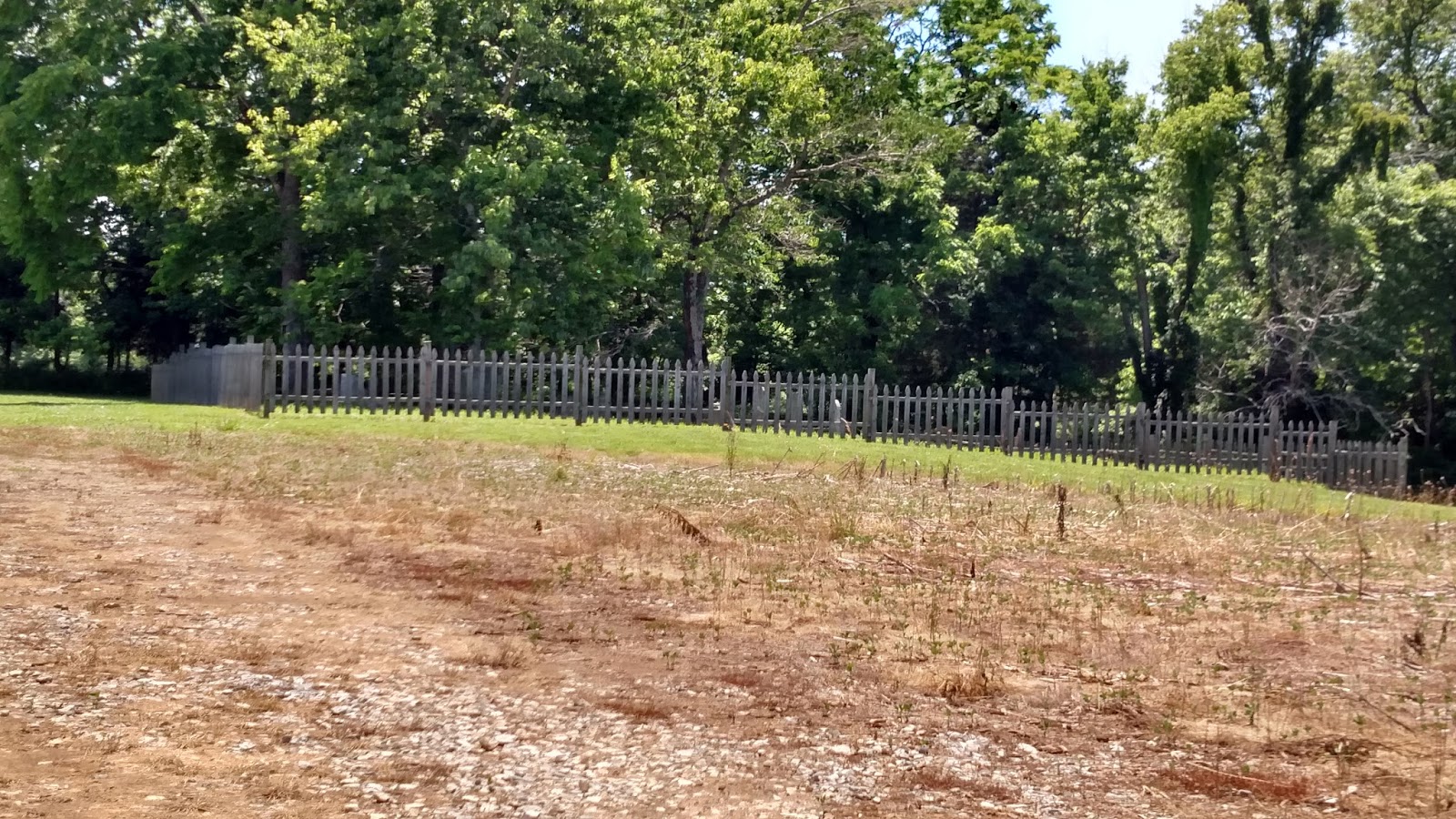
And there, on the right, set back in a grove of trees, were headstones surrounded by fencing. 

There wasn't a single living soul in sight. I drove past the cemetery and continued down the dirt road in hopes of finding a farmhouse where I could ask permission to visit the cemetery. I finally backed the car up and set about exploring this incredible family treasure.


Joseph Easley Sr. and Catey Deatherage Easley's (my third great-grandmother, 1767-1850) graves are marked simply with rough-hewn stones. I suppose at one time there may have been discernable markings on them.


Joseph Easley Jr.'s is more elaborate (click on it to see detail).

The inscription reads:

Joseph Easley Jr.
Born Mar. 18, 1805
Died Feb. 28, 1883
Not lost, blessed thought.
But gone before
Where we shall meet
To part no more.

I'll leave you with this one: Col. Merideth Hieatt (1785-1868), one of Joseph Jr. and Elizabeth's sons-in-law. 


The cemetery is just a short walk across a field from the narrow dirt road (that's my car). I stayed outside the fence the entire time.


Kenneth and Linda Pratt, the current owners of the farm, are not related to the Easley family. After I returned home to Pasadena from my Freedom Tour I wrote them a note thanking them for maintaining the Easley Cemetery so beautifully. 

As the current keepers of this hallowed ground, I appreciate their dedication to this Easley family treasure. I was sorry I didn't find their house.

May the Easley Cemetery continue to be honored and respected for many generations to come.


All photos were shot by yours truly.

Thursday, October 13, 2016

Manakin Town via Jamestown via England via France

I was born Martha Ann Easley 66 years ago today and have been called Ann from that moment on.

I come from good, hearty stock on my father's side. In America, it began with Robert Esle (1655-1711), my sixth great-grandfather. He was a French Huguenot, born in Ansouis, Provence, who sailed to the British Colony of Virginia by way of England at the age of 20, arriving in Jamestown in 1675. 


He was an early arrival from France; King Louis XIV's revocation of the Edict of Nantes 10 years later led to 600 Huguenot refugees coming to Virginia to escape persecution by the French government and the Roman Catholic Church.

He changed the spelling of the last name to Esley, probably to anglicize it, and it was changed again to Easley by his sons after his death. 

On Oct. 20, 1704, he was granted 133 acres of land at Fine Creek on the south side of the James River near Manakin Town, also known as King William's Town, a 10,000-acre settlement created for Huguenot refugees on the Virginia frontier about 20 miles northwest of present-day Richmond (his land holdings eventually grew to 900 acres). He settled there with his wife Ann Parker Esley and their six children, including my fifth great-grandfather, John Robert Easley (1686-1742).

Today I am pleased to say this acreage is mostly open space -- part of the James River Park System -- and still bears the Huguenot name in modern times. I don't know if any excavation has ever taken place.


As new generations of Easleys came along, some of them decided to venture west. They created farms, braved many dangers and adventures and settled in for the long term in Kentucky and Tennessee.

One of these was my third great-grandfather, Joseph Easley Sr. (1764-1849). He and my third great-grandmother Mary Catherine Deatherage Easley, who was called Catey, settled on 171 acres in Connorsville, Kentucky (later renamed Harrisonville), about 30 miles southwest of Frankfort.  

Most of Joseph and Catey's 13 children were born on the farm, including my second great-grandfather, Joseph Easley Jr. (1805-1883).

Here are photos of Joseph Easley Jr. and his wife, my second great-grandmother Elizabeth McWilliams Easley (1818-1894).


For years I have known about the private Easley Cemetery that is on the farm and includes the graves of Joseph Easley Sr., Joseph Easley Jr., their respective wives and many of their offspring.

My bucket list has included a visit to the cemetery if I ever got an opportunity to travel to Kentucky. That opportunity presented itself at last during my Freedom Tour last summer.

I'll tell you all about that next week.

Saturday, June 25, 2016

Freedom Tour -- Day 25

Yesterday (Friday), after spending four make-'em-count days with family in Northwest Arkansas and Wichita, Kansas, I drove six and a half hours from Wichita to Ogallala, Nebraska. The roads were mostly two-lane highways through the Kansas plains and Nebraska prairie, with very few other cars in sight...and cornfields as far as the eye can see:

Since I haven't done a Freedom Tour blog post since last Sunday (June 19), allow me to back up a few days. After I arrived in Bella Vista, Arkansas, in the spectacular Ozark Mountains on Sunday evening to visit with my sister Charlou, brother-in-law Bill, cousin Bonnie, cousin Judy and her husband Ken, it was nice to just relax for three full days. 

While it's great to be on the road, relaxation with loved ones is a necessity from time to time.

I don't have any photos of family to share -- just Lake Avalon, where my sister's home is in Bella Vista. The top photo was shot from the upstairs deck and the bottom from the ground-level hammock (thank you, Matt).


Then on Thursday morning I drove about four hours to Wichita, Kansas, to spend the afternoon, evening and the next morning with my cousin Alice who lives in this lovely, spacious home in the historic Riverside neighborhood.


After a leisurely breakfast out, we parted ways (sob) and I hit the road again, which catches you up to yesterday!

I just realized I never snapped a photo of Alice. Here she is (I can't take credit for this one):


On that long drive yesterday to Ogallala, Nebraska, the two-lane highway went through a number of tiny little towns.


At one point I filled my car up with gas next door to a John Deere dealership. 

Dear John Deere: You give farmers all the best toys! 


I saw a sign about a mile from Gothenburg, Nebraska, about a historic Pony Express station and museum so I had to veer off the beaten path and take a look. 

Young men were hired to deliver mail between Missouri and California in the span of only 10 days, guaranteed, which was unheard of at the time. This was before the transcontinental telegraph system was completed, so the only way to communicate was via letter, and that sometimes could take weeks if not months, especially on the isolated plains and prairies. 

The only available options were mail delivery by overland stagecoaches or by steamship routes that had to go around the tip of South America. In other words, not exactly express delivery!

Wanted: Young, skinny, wiry fellows, 
not over 18, must be expert riders, 
willing to risk death daily. 
Orphans preferred.

So a relay system was developed that was nearly 2,000 miles long with 190 stations, most of them in Nebraska, Wyoming, Utah and Nevada. Each Pony Express rider raced about 75 miles on horseback, then handed the saddlebag with mail pouches to another waiting rider with a fresh horse. And so on and so on. William "Buffalo Bill" Cody was one of the riders. 


Pony Express only lasted from spring 1860 to autumn 1861 but it remains a legendary chapter in American history.

This historic Pony Express station on the Oregon Trail was moved 25 miles from its original site on the prairie near the Platte River to Gothenburg's Ehmen Park in 1931 after the property owner donated it to the city. Like other stations, this one included sleeping quarters, a corral, food for riders and horses, as well as someone to run the station. 


An iconic image of a Pony Express rider and his galloping horse. 
Inside, which is now a museum, there are many Pony Express artifacts. 


Click here for more info about this station as well as a video about the Pony Express.

Final thoughts about yesterday:

I remember learning about the Pony Express when I was in elementary school. Back then, history was brought to life by exciting stories relayed by great teachers that left me hankering for more. I've been a student of history ever since.

Visiting the Pony Express station was a fascinating and educational break in the day that also gave me an opportunity to stretch my legs in the fresh air by walking around the park.

There doesn't seem to be much to write home about in Ogallala, Nebraska, where I spent the night last night, with the exception of the Prairie Theater that shows first-run films, which is unusual for such a small town in the middle of nowhere (on the marquis it reads "Independence Day" and "Finding Dory"). . .


. . .and a replica of an Old West town that features a short stretch of ersatz shopfronts.


You'll have to wait for tomorrow's blog post to see what I did today.

I'm loving my Freedom Tour!


Pony Express route map courtesy of Mike Reagan.