Search This Blog

Showing posts with label 1910s. Show all posts

Thursday, February 19, 2015

Mystery History -- Solved! Special Edition #1


Bill DePoto's guess, "Construction of Christian Science Temple, South Oakland Ave.," that he placed in the suggestion box at the Pasadena Museum of History was correct and he wins the fabulous prize for Mystery History Special Edition #1.

In the 1910 photos above and below, construction of the First Church of Christ, Scientist is in various stages at the southeast corner of Green Street and Oakland Avenue.


The church cost $100,000 to build. It was designed by architect Franklin P. Burnham of Chicago, who also designed the Georgia State Capitol, Carnegie Art Museum and the Riverside County Courthouse

In 1903 Pasadena's burgeoning Christian Science community built its first church at the southeast corner of Colorado Boulevard and Madison Avenue:


 It was expanded in 1905:


1905 was also the year the land at Green and Oakland was purchased. After years of fundraising drives and proposals from various architects, Burnham was hired and construction began in 1910. It was completed the following year. 


The church had the largest number of square feet of any building in Pasadena at the time. It was designed to be completely fireproof and was topped by one of the earliest examples of a reinforced concrete dome.

Nearly a century after this church was built, structural work revealed the need for a large-scale seismic upgrade. The project team, led by Architectural Resources Group, analyzed the building’s condition, installed  a major structural system that is virtually invisible, and restored historic finishes. And they did it all in 18 months with a budget of only $3.5 million, without disrupting a single church service.

The retrofit and restoration project received the prestigious Preservation Award from the Los Angeles Conservancy in 2009.

The church today at 80 S. Oakland Ave.:


Pasadena's rich history includes incredible architecture of churches throughout the community, past and present.


Many thanks to Pasadena Museum of History (Benshoff Collection, #14), Los Angeles Conservancy, Architectural Resources Group, Univerity of Southern California and Pasadena Church of Christ, Scientist.

Thursday, August 21, 2014

Mystery History -- Solved!

The winner this week is Terrie with her 4:10 p.m. Tuesday guess "Fenyes Mansion with Tom Nix" (sic). 

In the 1918 photo above, a scene from the silent movie "Western Blood" starring Tom Mix and Victoria Forde is filmed at the Fenyes Mansion in Pasadena. Other scenes were shot in wide open spaces near Santa Clarita.

Mix and Forde had starred together in several Fox Film Corporation short films; this was their first full-length Fox feature. They got married shortly after the film's release. 

Tom Mix was an honest to goodness cowboy who had been a U.S. Marshal in Oklahoma and a Texas Ranger. He was the first Hollywood superstar, popularly known as King of the Movie Cowboys and starring in 283 films from 1909 to 1940. 

He also had a traveling circus and wild west show. 

Here is the same side of the Fenyes Mansion today that is in the top photo:

Eva Scott Fenyes was the first person in Pasadena to allow film production on private property; the first movie filmed at the Fenyes Mansion was D.W. Griffith's "When Kings Were the Law" in 1912.

The most recent film with scenes shot there was "The Social Network" in 2010. Scenes were also shot at the Pasadena Masonic Temple and one of the fraternity houses at Caltech. (Thanks to Bellis for the clarification.)

You can see a more complete list of films shot at the Fenyes Mansion here.

One final photo: The Tom Mix Circus and Wild West Show came to Pasadena in March 1936. I'm not sure which neighborhood this was. Anybody?


A lot of filming takes place in Pasadena. Is your property ready for a starring role? Click here for more information and to register. 


Many thanks to Pasadena Museum of History, Pieces of Our Past, Circus World, Silent Hall of Fame and Big Old Houses.

Thursday, April 3, 2014

Mystery History -- Solved!


Petrea was closest with her 8:48 p.m. Tuesday guess "Must be some early event at Tournament Park," so I'm declaring her the winner this week. 

In the 1911 photo above, equestrians compete in a Tournament of Roses horsemanship contest at Tournament Park.

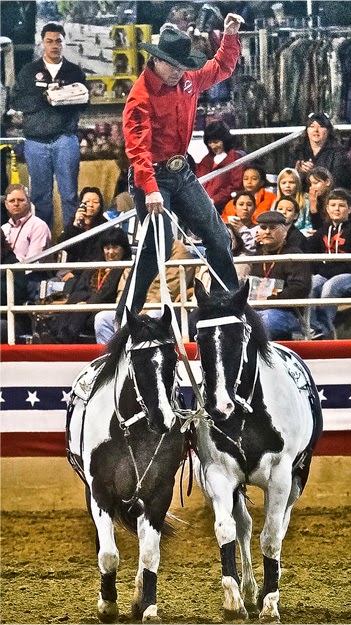
Horses have been an important part of the Tournament of Roses from the beginning.

The chariot races at Tournament Park were de riguer.


And of course the Rose Parade began with horse-drawn carriages decorated with flowers, also at Tournament Park.


Eventually famous equestrians got in the act. Here's Hopalong Cassidy in the 1952 Rose Parade, surrounded by adoring young fans.


Equestfest at the Los Angeles Equestrian Center in Burbank a couple of days before the Rose Parade has been part of Tournament of Roses activities for several years. 


It's a family-friendly day of roping acts, jousting demonstrations, precision riding teams and a host of other equestrian exhibitions, plus food, live music and more. You can also stroll through the stables and talk to the riders. 

All you need is a ticket (available online beginning this fall).


Many thanks to Pasadena Museum of History, Tournament of Roses, and The Photo Forum for the photos.

Thursday, March 6, 2014

Mystery History -- Solved!


I stumped everybody this week. 

In the 1912 photo above, Pasadena education and civic leaders lay the cornerstone of Pasadena High School at Hill and Colorado as hundreds look on.

The stone was engraved with "Polytechnic High School A.D. 1912."

In 1874, one week after the first school board was elected, the Pasadena Polytechnic High School was founded with 16 students in the home of William T. Clapp at 625 N. Orange Grove.

Three years later the students and teachers moved out of the Clapp home and into a new building at the southwest corner of Marengo and Walnut. The school was renamed for Benjamin "Don Benito" Wilson who donated five acres of land for the building.

By 1899 there were more than 100 students, 33 of them seniors who graduated from the school.

And by 1912, due to overcrowding, the school moved again -- this time to 18 acres at Hill and Colorado. The campus displaced a citrus orchard and the old Grant School originally built there.


The campus featured classically beautiful structures, including the vast Horace Mann Administrative Building...


...and the Jane Addams Domestic Sciences Building:


This photo is from the 1920-21 Pasadena City Schools Annual Report:


I wrote a Mystery History post in 2011 about the demolition of the Horace Mann building in 1934.


By 1923 an additional 19 acres were purchased, expanding the campus to 37 acres. The property was now bounded on the north by Colorado Boulevard, the east by Sierra Bonita Avenue, the south by Blanche Street (later renamed Del Mar) and the west by Hill Avenue. 

In 1928 Pasadena High School merged with Pasadena Junior College (there's a long story there that I won't get into here).

Finally, in 1960, Pasadena High School opened at its present location at 2925 E. Sierra Madre Blvd. 


See even more history of Pasadena High School in this wonderful Pasadena City College 75th anniversary book.

Thursday, February 27, 2014

Mystery History -- Solved!


John wins with his 8:33 a.m. Tuesday guess "Andrew Carnegie with George Ellery Hale (arm in arm) visiting Mount Wilson."

In the photo above, Andrew Carnegie, center, walks arm-in-arm with George Ellery Hale, right, outside Mount Wilson Observatory during Carnegie's week-long visit in 1910 to see what his money had made possible.

Carnegie was a self-made, wealthy industrialist who founded the Carnegie Institution of Washington (now called Carnegie Institution for Science), which funded the Mount Wilson Observatory. 

Carnegie also built Carnegie Hall, founded the Carnegie Corporation of New York, Carnegie Mellon University and so much more.

Hale, a force to be reckoned with in Pasadena, founded the observatory and was instrumental in the founding of Caltech, which previously had been Throop University.

As a member of Pasadena's first Planning Commission, Hale guided the master plan for the Civic Center -- which now consists of Pasadena Public Library to the north and Pasadena Civic Auditorium to south, with City Hall, the Post Office, Police Building, Courthouse and other structures in between.

The Hale Building in the Civic Center, which houses the Pasadena Planning Department and the Permit Center, is named in his honor.


I love this more formal photo taken at the Hotel Maryland during Carnegie's visit. Left to right are Hale, J.H. McBride, John Muir, H.F. Osborn, John Daggett Hooker, J.A.B. Scherer and Carnegie.


The elegant headquarters for the Carnegie Institution for Science's Carnegie Observatories is at 813 Santa Barbara Street in a quiet Pasadena neighborhood off North Lake Avenue. It features beautiful grounds; you can explore inside and meet the astronomers during an annual open house every October, which I highly recommend. 


I'll leave you with this photo of Carnegie and Hale inside Mount Wilson Observatory in front of the 60-inch telescope.


Many thanks to Caltech, American Institute of Physics, The Carnegie Observatories and Mount Wilson Observatory for the photos.


Thursday, November 15, 2012

Mystery History -- Solved!


I'm calling a tie between Wonder Wanda, who specified the Old Mill at Busch Gardens and some sort of movie-making, and Barbara Field, who was spot-on with the name of the movie.
 
In the 1915 photo above, Charlie Murray, Vivan Edwards and cast stand in front of the Old Mill at Pasadena's Busch Gardens in the Arroyo Seco for a scene in the film "Hogan's Aristocratic Dream."

The Old Mill still stands, although it is now on private property.

Mack Sennett brought cast and crew to the location for production of the film short.

Here's an excerpt from the book "Mack Sennett's Fun Factory" by Brent Walker:

Tramp Hogan, with his bum "valet" Dunn, dreams he is living the life of royalty in an 18th century setting but is awakened by farmer Haye's pitchfork.

In addition to the Old Mill, the film's locations included the Grecian pergola. . .


. . .arroyo fountain. . .


 . . .and rustic bridge.


I haven't found a clip online of Hogan's Aristocratic Dream. I hope it's not lost to the ages!

Many thanks to Pasadena Museum of History and Pasadena Public Library.

Thursday, November 1, 2012

Mystery History -- Solved!


Although there were some creative guesses, I stumped everybody this week.

In the 1910 photo above, a float passes by during the Shriners Electric Parade, which took place in Pasadena that year because the annual Shriners National Conclave was here. Other years it was everywhere from New York to L.A.

Thousands of incandescent bulbs were used to outline the designs of the floats.

This is the only other photo I have of the 1910 parade in Pasadena; can you find the people on and next to the float?

 
The floats were built on large wooden flats with wheels and operated by overhead trolley wires, which supplied the power.
 
Just for fun, here's a Pasadena & Pacific electric trolley car at Colorado Street and Raymond Avenue in the late 1800s, operated by those very same wires:


Many thanks to the Pasadena Museum of History.


Thursday, September 6, 2012

Mystery History -- Solved!


Dale wins with his 1:15 p.m. Tuesday guess "This is the La Pintoresca/Painter/Pasadena Hotel after the fire which destroyed it in 1912."
 
In the Jan. 2, 1913, photo above, the La Pintoresca Hotel lies in ruins at the northeast corner of Fair Oaks Avenue and Washington Boulevard after being destroyed by a fire.

When it was first built it was called the Painter Hotel.

 
Check out the trolley cars in the lower left and right corners of this photo:
 
 
After significant landscaping was completed, the name was changed to La Pintoresca because of the picturesque setting:


I did a Mystery History post about the hotel's gardeners in 2010, which you can see here.
 
Over the years there were substantial additions to La Pintoresca Hotel, making it one of the largest hotels in Pasadena.
 
 
It was sold in 1905 and then destroyed by fire seven years later.
 
Here's an excerpt from my favorite reference book, "Pasadena: Historical and Personal" by John Windell Wood:

"The Painter -- or as it became, La Pintoresca, i.e. 'the picturesque' -- was built by J.H. Painter and his two sons, Alonzo and M.D., in 1887. J.H. Painter had been the partner of B.F. Ball in the Painter & Ball Tract and had amassed much money thereby. A fine and sightly spot in North Pasadena was selected, and upon it a fine hotel was built and opened for tourist trade in 1888, under the management of M.D. Painter. The investment cost about $100,000, and prospered for several years, but it was in 1905 sold to others and was destroyed by fire December 31st, 1912. The grounds it occupied were purchased by the city in 1914 and now comprise one of the city's handsomest parks, small it is true, but like the name it bears, picturesque and beautiful and much appreciated by the residents of North Pasadena."


Many thanks to Pasadena Museum of History.

Thursday, August 9, 2012

Mystery History -- Solved!


Well, I stumped everybody this time. In the photo above, soldiers on military motorcycles travel past the Maryland Hotel during the Liberty Loan Parade in 1917.

There was much more to the cross-town parade than motorcycles:


There were Liberty Loan Parades throughout the U.S. during World War I.

Citizens were encouraged to loan money to the government via the purchase of war bonds, which were promoted as a patriotic duty.


Even children, including Boy Scouts, promoted and participated in the program:


There were four issues of Libery Bonds, and more than $21 million was raised nationwide to help fund the war effort for the U.S.  and its allies.

After the war, each bond could be redeemed for its purchase price plus interest.


Pasadenans were involved in the war effort from beginning to end.

Here's an excerpt from Ann Scheid's book "Historic Pasadena: An Illustrated History."

The outbreak of World War I in 1914 gave a great boost to Pasadena's tourist trade, as wealthy Easterners could no longer frequent their favorite resorts in Europe. And Pasadenans and visitors alike organized relief efforts, beginning in late 1914 with the founding of a local chapter of the American Red Cross. Dr. James Scherer and Mrs. James A. Garfield were among the founders. The local chapter distinguished itself by being the first to organize and equip a Red Cross Ambulance. The Pasadena chapter sent thousands of surgical dressings, hospital supplies, and refugee garments to Europe and in three years collected almost $200,000 for war relief. Other relief groups in Pasadena added the Belgians, Italians, Syrians, and Armenians.

In drives for Liberty Loans and War Savings Stamps, Pasadenans subscribed over $9 million. Education in food conservation and thrift extended down to the smallest children, who were encourage to perform small household tasks for money; in ten weeks Pasadena schoolchildren earned and saved $5,500 for the war effort. A fabricated ship, "The Good Ship Thrift," built over the body of an automobile, toured the town campaigning for membership and enrolling over 2,100 citizens. Once the United States entered the war, the Navy League (later the Army and Navy League), under the leadership of Mrs. Myron Hunt, set up a knitting program, with 4,000 knitters knitting 61,000 garments in little over a year.

This photo shows the Pasadena chapter of the American Red Cross entry in the 1918 Rose Parade:


Many thanks to Ann Scheid and the Pasadena Museum of History.